
Charity website design: a UK guide from a South Wales studio.
Donations, Gift Aid, accessibility and trust signals for charities across South Wales and the UK, from the team behind the Wales Ape & Monkey Sanctuary site.

In a sector where every pound matters, your charity website is often the difference between a scroll past and a donation. With over 168,000 registered charities in England and Wales competing for supporter attention, a professional online presence isn't a luxury, it's essential for survival. Whether you're a local community group, an established nonprofit, or a Community Interest Company (CIC), your website needs to inspire action while demonstrating the transparency and trustworthiness that donors demand.
This comprehensive guide covers everything UK charities need to know about website design in 2026. We'll explore which features actually drive donations, how to integrate Gift Aid seamlessly, what accessibility standards you must meet, and how much charity websites cost. Whether you're launching your first nonprofit website or replacing an outdated site that isn't converting visitors into supporters, this guide provides actionable insights specific to the charitable sector. And if what you actually typed was closer to "charity website agency South Wales", the short answer is that we are one: a studio between Neath and Swansea with the Wales Ape & Monkey Sanctuary and Be-Life Community CIC live in our portfolio. The section near the end covers that in full; everything between here and there is the how.
Why charity website design matters more than ever
The charitable sector has undergone massive digital transformation. Supporters increasingly expect online donation options, transparent impact reporting, and the ability to engage with causes digitally. Your website isn't just an information resource, it's your primary fundraising tool, volunteer recruitment platform, and trust-building mechanism rolled into one.
Consider how potential donors find charities today. They search Google for causes they care about, see social media posts about your work, or receive recommendations from friends. Within seconds of landing on your website, they're making judgments about your credibility based on design quality, content clarity, and professional presentation. A dated website with clunky donation processes suggests an organisation that might not manage their funds effectively, not the impression any charity wants to create.
Your website also differentiates you in a crowded market. With tens of thousands of charities vying for limited donor pounds, your online presence must communicate why supporting your cause matters and why supporters should trust you with their donations. A well-designed website that clearly demonstrates impact and makes giving effortless wins supporters over competitors with worthy missions but inferior digital experiences.
Essential features every charity website needs
Not all charity websites are created equal. Based on our experience building websites for nonprofits and analysing what actually converts visitors into donors, here are the five foundational features every charity website must include.
Prominent donation system
Your donation system should be visible on every page, not hidden behind multiple clicks. Effective charity websites feature donation buttons in headers, within content areas, and as floating elements that follow visitors as they scroll. The system should offer multiple giving options: one-off donations, monthly recurring gifts, and custom amounts. Suggested donation tiers (£10, £25, £50, £100) with impact statements ('£25 provides school meals for a week') significantly increase average gift sizes.
Payment processing must be seamless. Stripe, PayPal, and GoCardless integration enables card payments and direct debits without redirecting visitors to external sites. The fewer clicks between decision and donation, the higher your conversion rate. Mobile payment options like Apple Pay and Google Pay are increasingly expected, particularly among younger donors.
Gift Aid integration
Gift Aid adds 25% to eligible donations at no cost to donors, potentially worth thousands of pounds annually to your charity. Your website must make Gift Aid declarations simple and HMRC-compliant. A clear checkbox with the standard declaration text, donor name and address collection, and automated Gift Aid reporting integration transforms your donation process into a significant revenue multiplier.
Explain Gift Aid in plain English. Many donors don't understand what it means or whether they qualify. A brief explanation, 'If you're a UK taxpayer, Gift Aid lets us claim an extra 25p for every £1 you donate, at no extra cost to you', dramatically increases tick rates. Consider a visual showing how a £20 donation becomes £25 with Gift Aid.
Clear mission and impact statement
Your mission statement should be prominently displayed within seconds of landing on your homepage. Visitors need to immediately understand: what problem you're solving, who you're helping, and what you've achieved. Abstract mission statements fail; concrete impact wins. 'We've provided 50,000 meals to families in South Wales this year' is far more compelling than 'We work to end food poverty.'
Impact reporting builds the trust that converts browsers into donors. Annual reports, project updates, beneficiary testimonials, and statistical achievements should be easily accessible. Donors increasingly demand transparency about how their money is spent, charities that demonstrate clear impact reporting receive more and larger donations.
Mobile-responsive design
Over 60% of charity website traffic now comes from mobile devices. Donors researching causes on their commute, responding to social media appeals, or giving impulsively after seeing news coverage are all on phones. If your donation process doesn't work flawlessly on mobile, you're losing significant revenue. Test every element of your website on various devices, not just how pages display, but how forms function and how payments process.
Mobile responsiveness also affects search engine rankings. Google prioritises mobile-friendly websites in search results, meaning poor mobile experiences directly reduce your visibility to potential supporters searching for causes like yours.
Charity Commission registration display
Displaying your Charity Commission registration number is legally required for fundraising activities and essential for building trust. Your registered charity number should appear in your website footer on every page, along with your registered charity name exactly as it appears on the register. For Community Interest Companies (CICs), display your Companies House registration number and CIC status clearly.
Consider linking your registration number directly to your Charity Commission register entry. This allows donors to verify your status independently, building confidence in your legitimacy. In an era of charity scams, this transparency differentiates genuine organisations from fraudulent operations.
High-priority features for effective charity websites
Beyond the essentials, these features significantly enhance your charity website's effectiveness and should be prioritised for organisations with growth ambitions.
Accessibility compliance
Accessibility isn't optional for charities, it's both an ethical imperative and increasingly a legal requirement. WCAG 2.1 AA standards ensure your website works for visitors using screen readers, keyboard navigation, and other assistive technologies. This includes text alternatives for images, sufficient colour contrast, readable fonts, video captions, and logical page structures.
For charities serving disabled people, accessibility compliance is essential for credibility. How can you claim to support disabled communities while excluding them from your website? Many grant applications now require evidence of accessibility compliance, making this investment doubly valuable.
Volunteer recruitment
Volunteers are the lifeblood of many charities. Your website should make volunteer recruitment straightforward with clear role listings, simple application forms, and compelling testimonials from existing volunteers. Explain the time commitment, skills needed, and impact volunteers make. A volunteer portal allowing shift booking and hour logging encourages ongoing engagement.
Different volunteer opportunities attract different people. Someone with two hours monthly has different capacity than someone seeking a career change into the charitable sector. Segment your volunteer opportunities accordingly, making it easy for visitors to find suitable roles.
Newsletter signup with GDPR compliance
Email remains the most effective channel for donor retention and repeat giving. Your website should capture email addresses with GDPR-compliant consent mechanisms. Be specific about what subscribers will receive, 'Monthly impact updates and appeals' sets appropriate expectations. Make unsubscribing easy; forced subscriptions damage trust.
Segment your email capture. Someone interested in volunteering has different communication needs than someone who's just donated. Multiple signup options with clear purposes build more engaged audiences than generic 'subscribe to our newsletter' forms.
Event listings and ticket sales
Fundraising events remain crucial for many charities. Your website should list upcoming events with online registration and ticket purchasing. Integration with Eventbrite, Ticket Tailor, or built-in ticketing systems removes friction from event participation. Include event details, accessibility information, and joining instructions in one place.
Charity website design trends 2026
Five interconnected trends are reshaping charity web design this year, all prioritising users and organisational values over superficial aesthetics.
Accessibility as Default moves beyond compliance checkboxes to genuinely inclusive design. Leading charities are building accessibility into every design decision, not retrofitting it later. Donation forms that work seamlessly with screen readers, event calendars with proper date formatting, and videos with professional captions are becoming standard expectations.
Sustainable Websites address growing environmental concerns. Digital carbon footprints matter to environmentally-conscious supporters. Efficient code, optimised images, and sustainable hosting reduce environmental impact while improving performance. Some charities now display website carbon badges demonstrating their commitment to digital sustainability.
Meaningful Trust Signals strategically placed throughout sites build donor confidence. Security badges, beneficiary testimonials with real photos, team member bios with photos, partnership logos from recognised organisations, and prominent links to annual financial reports reassure visitors without overwhelming them.
Ethical AI Use addresses growing concerns about chatbots, automated content, and personalisation. Charities must balance efficiency gains from AI tools with preserving the authentic human connection that inspires charitable giving. Transparency about AI use builds trust with increasingly savvy supporters.
Persona-Driven Navigation segments content for distinct audiences. Programme participants, educators, donors, corporate partners, and grant funders all need different information. Effective charity websites enable each visitor type to find relevant content quickly through intuitive navigation and audience-specific pathways.
Charity website costs UK: what to expect
Understanding realistic charity website costs helps you budget appropriately and make informed decisions about your digital investment. The table puts the UK bands side by side, with our own published prices in the middle column so you can see where a custom build sits.
| Route | Typical UK cost | What you actually get | Suits |
|---|---|---|---|
| DIY builder or template | £0 to £500 plus £10 to £30 a month | A theme with your logo, a donate button bolted on, no Gift Aid capture | A new community group proving it exists |
| Custom build, independent studio | £675 to £1,350 +VAT one-off, £39 to £65 +VAT a month (our Essential and Professional) | Custom-coded pages, donation flow with Gift Aid built in, volunteer and event forms, accessibility done properly, hosting and support included | Most local and regional charities and CICs |
| Custom build with integrations | £4,000 +VAT and up (our Bespoke) | Everything above plus CRM, member areas, merchandise, bookings | Charities with a paid team and systems to connect |
| Agency project | Typically £5,000 to £20,000 and beyond | Workshops, account management, strategy days, the build itself | National charities and funded programmes |
Starter charity websites suit small community groups and newly registered charities. These include essential pages (home, about, services, contact), basic donation integration, mobile-responsive design, and Charity Commission number display. Ideal for organisations primarily using social media for engagement, needing a professional home base for credibility.
Standard charity websites serve established local and regional charities with regular fundraising activities. Features typically include integrated donation systems with Gift Aid, volunteer recruitment functionality, event listings, news and blog sections, newsletter signup, and accessibility compliance. This represents the sweet spot for most growing nonprofits wanting to professionalise their digital presence.
Premium charity websites support larger regional or national charities with complex requirements. Features include full accessibility audits, CRM integration (Salesforce, Beacon, Donorfy), member portals, e-commerce for merchandise, advanced analytics, multi-language support, and sophisticated impact reporting dashboards. Custom integrations increase costs further.
A South Wales example: Wales Ape & Monkey Sanctuary
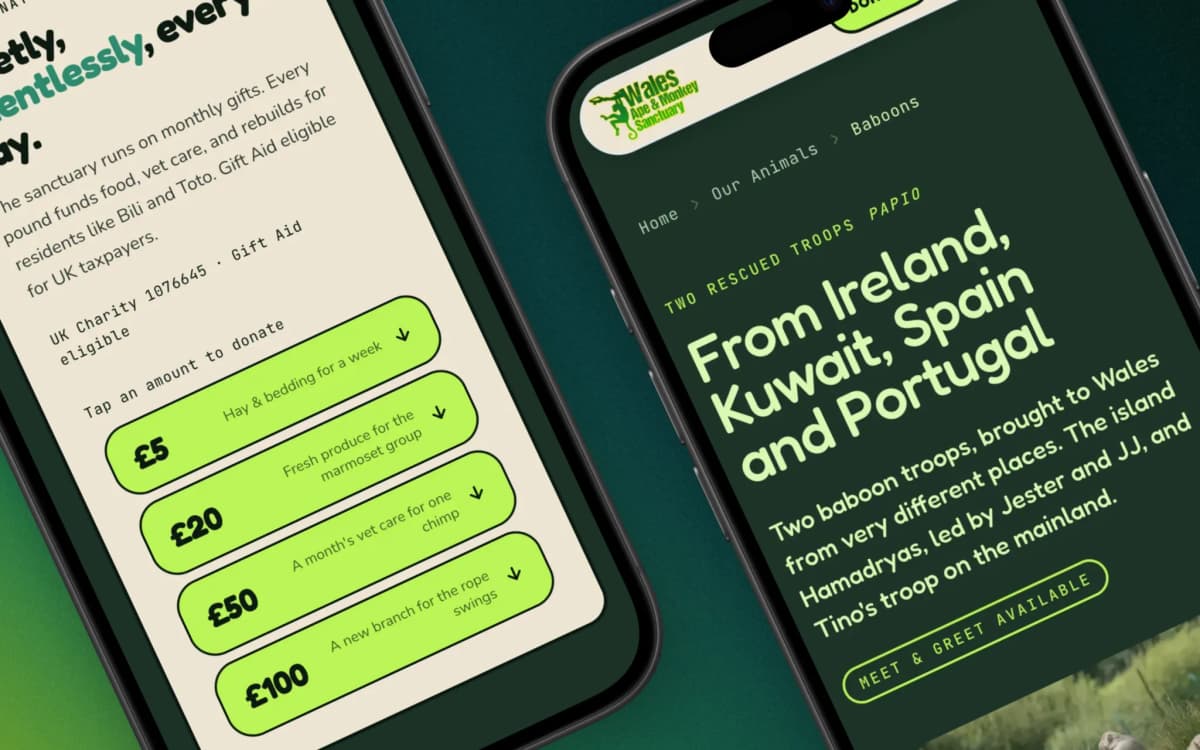
We built the website for the Wales Ape & Monkey Sanctuary, a working animal sanctuary in the Swansea Valley, and it puts the principles above into practice. Giving is one tap from anywhere: the donation flow takes custom amounts, builds the Gift Aid declaration into the form so eligible donations grow by 25% automatically, and works as well on a phone as on a desktop. Beyond donations, the site carries pages for over 200 resident animals and takes Meet & Greet bookings directly, turning casual visitors into supporters. If your charity or CIC serves South Wales, that is the standard your website should be aiming at.
Looking for a charity website agency in South Wales?
If that phrase is roughly what you typed into Google, here is the direct answer. We are a South Wales studio, based between Neath and Swansea, and the third sector is genuinely part of our portfolio rather than a page on a services list: alongside the Sanctuary we built the site for Be-Life Community CIC, a wellbeing and nature community interest company in Pembrokeshire, so we have worked with both a working animal charity and a CIC and understand the difference Gift Aid, trustees and community funding make to how a site gets scoped. Meetings anywhere from Carmarthen to Cardiff are an easy drive, you deal directly with Jack who builds every site himself, and charity budgets get the same published prices as everyone else, with no discovery-phase invoices before you see a number. Churches and chapels have their own version of this brief, the welcome page, online giving and the hall, and our church website design guide covers that ground in full.
At WebDev Wales, our packages start at Essential from £675+VAT for a professional charity presence, Professional from £1,350+VAT for nonprofits wanting donation integration, Gift Aid functionality, volunteer forms, and accessibility compliance, and Bespoke from £4,000+VAT for larger organisations with complex requirements. Every package includes a monthly plan covering hosting, SEO, maintenance, and support. We understand the budget constraints charities face and work to maximise impact within available resources.
Pre-launch checklist for charity websites
Before launching your charity website, ensure these critical elements are in place.
Trust and Compliance: Clear mission statement with evidence of impact displayed. Charity Commission registration number in footer. Privacy policy with cookie consent implemented. SSL certificate installed (HTTPS). Gift Aid declarations HMRC-compliant.
Functionality: Donation buttons prominent on every page. Multiple payment methods working. Gift Aid checkbox functioning. Mobile-responsive design tested on various devices. All forms submitting correctly. Newsletter signup capturing addresses.
Accessibility: Completed accessibility audit against WCAG 2.1 AA. Screen reader compatibility verified. Keyboard navigation working. Colour contrast sufficient. Alt text on all images. Video captions added.
Content: Impact statistics current. Team and trustee information accurate. Contact details correct. Event listings up to date. Blog posts spell-checked and edited.
Common charity website mistakes to avoid
We've reviewed hundreds of charity websites. Certain mistakes appear repeatedly, costing organisations donations and supporter trust.
Buried donation buttons force visitors to hunt for ways to give. Every page should include prominent, compelling donation calls-to-action. If supporters are motivated to give, don't make them work for the privilege.
Vague impact reporting fails to build donor confidence. 'We help vulnerable people' means nothing. 'We provided emergency accommodation to 347 rough sleepers last winter' demonstrates tangible impact. Specificity converts.
Outdated content suggests an inactive organisation. Old event listings, 2019 annual reports, and news from years ago raise questions about whether the charity still operates effectively. Fresh content signals vitality.
Complex donation processes lose motivated donors. Every additional field, every unnecessary page, every confusing step reduces completions. Streamline ruthlessly. Name, email, amount, payment details, Gift Aid, that's often enough.
Missing accessibility features exclude disabled supporters and damage credibility for charities working with disabled communities. Accessibility benefits everyone and demonstrates values-aligned operations.
Getting started: your charity website action plan
Ready to improve your charity's online presence? Here's a practical action plan based on your current situation.
If you have no website: Prioritise establishing a basic online presence with your mission, registration details, and donation capability. Even a simple five-page site provides credibility that social media alone cannot. Claim your Google Business Profile for local visibility.
If your website is outdated: Audit your current site against the essentials checklist above. Identify critical gaps (missing donation integration, no Gift Aid, poor mobile experience) and prioritise fixing these first. A phased improvement approach often works better than complete rebuilds.
If you're established but not converting: Focus on conversion optimisation. Test different donation amounts, experiment with button placement, A/B test appeals. Sometimes small changes, better images, clearer impact statements, simplified forms, dramatically improve results.
At WebDev Wales, we understand the unique requirements of charitable organisations. We've helped charities, CICs, and nonprofits across Wales create professional websites that inspire donations, recruit volunteers, and build lasting supporter relationships, all within the budget constraints that nonprofit organisations face.
Whether you need a complete new charity website, want to add donation functionality to your existing site, or need help improving accessibility compliance, we're here to help. Get in touch for a no-obligation discussion about your charity website needs.
Visit our pricing page to find the package that suits your organisation, or browse our services to see how we help community organisations get online. Your cause deserves a website that inspires action, let's make it happen.
Rather have this handled?
Everything in this guide is what we do all day for Welsh businesses: custom-coded sites, local SEO and a listing that stays busy.
Frequently asked questions.
Yes: we are based between Neath and Swansea and have built for the third sector directly, including the Wales Ape & Monkey Sanctuary's donation and Gift Aid flow and the site for Be-Life Community CIC in Pembrokeshire. Published prices apply to charities like everyone else, from £675 +VAT.
Yes. Displaying your Charity Commission registration number is legally required for fundraising activities, so put it in the footer of every page alongside your registered name. CICs should display their Companies House number and CIC status clearly.
Gift Aid lets you claim an extra 25p for every £1 a UK taxpayer donates, at no extra cost to them. Your donation form needs a clear HMRC-compliant declaration checkbox and must collect the donor's name and address, and explaining the scheme in plain English dramatically increases tick rates.
Starter sites suit small community groups, standard sites add donation systems with Gift Aid and volunteer recruitment, and premium builds add CRM integration and member portals. WebDev Wales packages start at Essential from £675+VAT, Professional from £1,350+VAT and Bespoke from £4,000+VAT, each including a monthly plan for hosting, SEO, maintenance and support.
Jack Warner
Founder, WebDev Wales · 28 September 2026

No obligation, replies within 24 hours
Rather have it handled for you.
Reading about local SEO is free. So is the quote for having every bit of it done properly, every month.