
Ecommerce website design in Wales: build a shop that sells.
How Welsh businesses should sell online: when you need a checkout and when you do not, the honest platform answer, and what a store that ranks really includes.
Ecommerce website design in Wales means one real decision before any talk of platforms or prices: does your business actually need a checkout, or does it need a better way to turn product interest into orders? A proper online shop for a Welsh small business typically runs £1,500 to £5,000 to build well, with template routes cheaper and enterprise projects far beyond. But we have built profitable "commerce" sites with no basket at all, and this guide starts where the sales pitches usually skip: what selling online should look like for your product, your customers and your county.
Start here: not every product belongs in a basket
The ecommerce industry sells checkouts the way garages sell tyres, but two of our own builds show why the basket is a choice, not a default. When we built for Bramwood Timber in Glynneath, the obvious brief was an online shop for garden buildings. We built an instant quote builder with live pricing instead, because a made-to-order shed with dozens of size and finish options is not an add-to-basket product; it is a configure-and-enquire product, and forcing it into a cart loses the conversation where the sale actually happens.
"They created a custom instant quote builder with live pricing so customers can design their own shed, plus a full gallery to showcase our work. Professional, efficient, and highly recommended." · Ian Watkins, Bramwood Timber
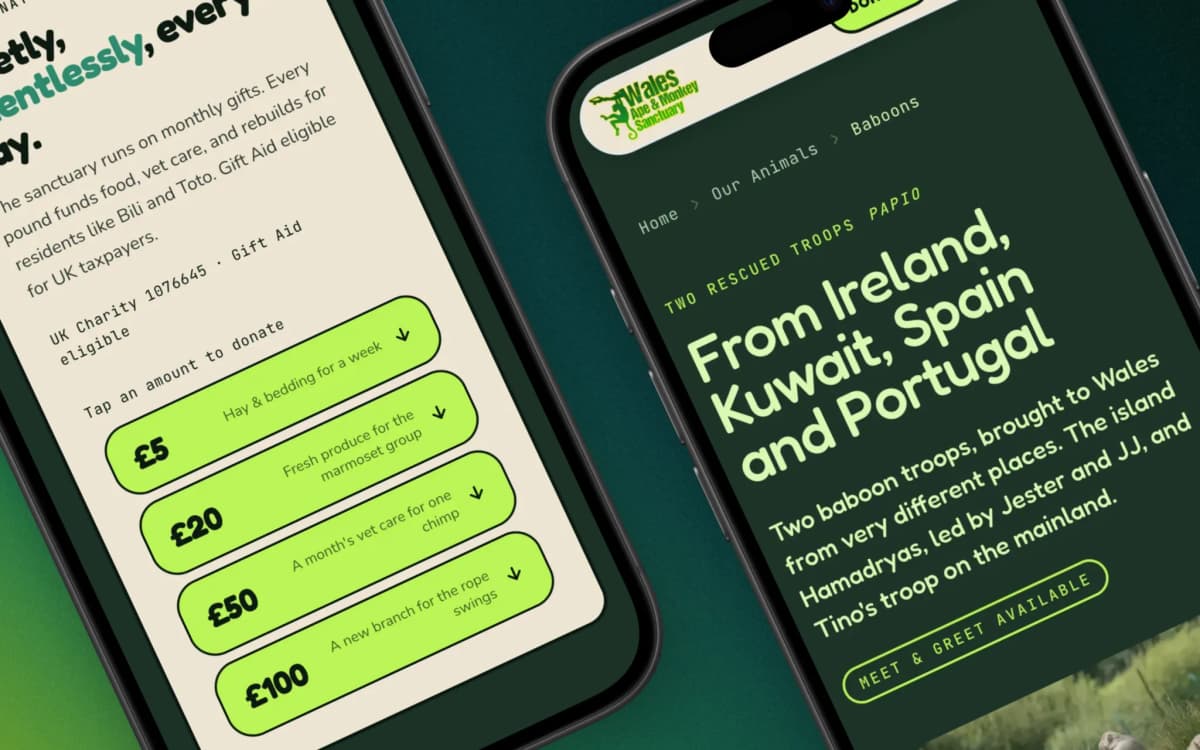
For the Wales Ape & Monkey Sanctuary, money moves the other way entirely: donations through a simple, secure checkout, with no products at all. Both are ecommerce in the sense that matters, money arriving through the website, and neither is a conventional shop. If your product is standardised and repeatable, a real store is right. If it is configured, quoted or booked, a smarter funnel usually outsells a basket.
The platform question, answered honestly
For businesses that do need a true shop, the platform conversation has three realistic answers, and our full Shopify versus WooCommerce comparison walks the whole decision including the three-year costs:
| Route | Typical territory | The catch |
|---|---|---|
| Marketplace only (Etsy, eBay, Amazon) | Testing demand, craft sellers | Fees on every sale, and the customer belongs to the marketplace |
| DIY builder (Shopify theme, Wix) | £30 to £80 a month, done yourself | Samey templates, slow pages, SEO ceiling |
| Custom storefront on Shopify | Serious independent retail | Higher upfront cost |
Our position is the third route, and it is worth explaining rather than asserting. Shopify has won the checkout: payments, stock, orders and refunds are handled by a platform that processes billions reliably, and you manage products from your phone with no developer involved. What we refuse to inherit is the part people dislike, the slow, interchangeable storefront themes. So we integrate Shopify into a custom-built storefront: your brand, your speed, your search visibility, with Shopify's engine underneath. The polish of bespoke, the reliability of proven.
What a Welsh online shop is really up against
Type any product into Google and the results are national: Amazon, the big chains, the category specialists. A Welsh independent cannot outspend them, and should not try. The winnable ground is different, and it is genuinely winnable. Local intent searches, "gift shop Carmarthen", "bike shop Swansea", still favour local businesses, especially with a complete Google Business Profile behind them. Click-and-collect and local delivery turn geography into an advantage the nationals cannot match. And provenance sells: "made in Wales" is a search term, a story and a margin, and a custom storefront can carry that story in a way a marketplace listing never will.
The practical upshot: a Welsh shop's ecommerce strategy is usually local-first, national-second. Win the searches with your town in them, serve the customers who can reach you, and let the wider UK orders compound on top.
Our own Search Console data backs this up: some of the most consistent ecommerce searches reaching our site pair the word with a place, particularly around Carmarthen and the west, where independent retail is strong and well-optimised competition is thin. A shop in that position that gets its storefront, product pages and local profile right is not fighting Amazon; it is fighting two or three nearby rivals who mostly have not tried.
What a proper ecommerce build includes
Whatever the platform, a store built to sell rather than to exist includes the same core work: a storefront designed on your brand rather than a theme, product and catalogue setup done properly the first time, reliable checkout, payments and inventory, a mobile-first shopping experience (most first visits to a local shop's site happen on a phone), and SEO-ready product pages so individual products can rank, not just the homepage. That last one is quietly the biggest gap in template shops: products buried in identical markup never surface for the searches people actually make.
Speed belongs on that list too. Every second of load time costs conversions, and shoppers comparing you against Amazon have Amazon's patience. It is why the custom storefront matters commercially, not just aesthetically.
Product pages are where shops are won and lost
Homepage design gets the attention, but nobody adds a homepage to a basket. The product page does the selling, and the difference between one that converts and one that leaks is unglamorous. Photography first: customers cannot pick the product up, so the photos are the product, and phone snaps against a cluttered stockroom quietly kill sales that better images would have closed. It is why product photography is one of our services rather than an afterthought. Then the words: a description written in your voice that answers the questions a customer would ask across the counter, sizes, materials, what it works with, what it is not, beats a manufacturer's paragraph pasted onto four hundred sites. Delivery cost and time belong on the product page itself, not hidden at checkout, because surprise postage is the single biggest reason baskets get abandoned. And reviews belong beside the product they praise, where the doubt actually lives.
None of this needs a bigger budget so much as it needs doing deliberately, once, per product. It is also exactly the work that separates a store Google ranks from a catalogue it ignores.
What it costs to run after launch
An honest ecommerce conversation includes the running costs, because a shop is a running thing. Expect three lines: Shopify's own subscription (entry tiers run roughly £20 to £30 a month), card processing fees taken as a small percentage of each sale, which every payment provider charges in some form, and the upkeep of the site itself, which for our builds is the same monthly plan from £39 +VAT that covers hosting, SSL, backups, SEO monitoring and minor content changes. What you should not budget for is a developer on retainer for everyday changes: products, prices and stock are yours to manage from Shopify's admin, from your phone if you like.
Against those costs, put the arithmetic of your average order. A shop clearing one £40 order a day covers its entire running stack many times over; the build cost is the only real hill, and it is climbed once.
Already running a store that underperforms?
A rebuild does not mean starting again. Products, customers and order history move across, and the storefront gets rebuilt properly around them. The businesses that come to us in this position usually name one of three frustrations: the site is slow and looks like everyone else's theme, nothing ranks except the homepage, or day-to-day product changes need a developer. All three are storefront problems rather than platform problems, which is exactly why the migration path keeps the engine and replaces the front.
Timelines and money
Most shops launch within the same 2 to 6 week window as any of our builds, depending mainly on catalogue size: twelve products is a different job from four hundred. On cost, ecommerce is quoted per project rather than off a menu, because a twelve-product farm shop and a four-hundred-line parts retailer are not the same build; for the full market picture of what stores cost across the UK, our guide to ecommerce website costs breaks down every band. What we promise on every quote: it is written, it is itemised, and the published prices for our standard builds tell you the kind of value ladder you are stepping onto.
Where to start
Start with the first question in this guide, not the platform. What has to happen for money to arrive through your website: a basket, a quote, a booking or a donation? Answer that and the rest of the decisions fall into order, and it is a conversation we are happy to have before any money changes hands. Tell us what you sell via the ecommerce service page and you will get a straight recommendation, including, occasionally, "you do not need a shop at all", from people who have built both kinds and can show you them live.
Rather have this handled?
Everything in this guide is what we do all day for Welsh businesses: custom-coded sites, local SEO and a listing that stays busy.
Frequently asked questions.
A proper custom shop typically runs £1,500 to £5,000 to build, with DIY template routes cheaper and large catalogues costing more. Ecommerce is quoted per project because a twelve-product farm shop and a four-hundred-line retailer are different jobs.
Shopify, integrated into a custom-built storefront. Shopify handles payments, stock and orders reliably and lets you manage products yourself, while the custom build removes the slow template storefront that makes most Shopify sites look identical.
Yes. Products, customers and order history move across, and the storefront gets rebuilt properly around them. Slow themes, homepage-only rankings and developer-dependent updates are storefront problems, not reasons to start again.
Not always. If your product is configured, quoted or booked rather than picked off a shelf, a quote builder or booking flow usually converts better than a basket. We have built both and will tell you honestly which fits.
Three lines: Shopify's subscription from roughly £20 to £30 a month, card processing fees as a small percentage of each sale, and site upkeep, which for our builds is the monthly plan from £39 +VAT covering hosting, SSL, backups and SEO monitoring.
Jack Warner
Founder, WebDev Wales · 18 August 2026
Keep reading.

No obligation, replies within 24 hours
Rather have it handled for you.
Reading about local SEO is free. So is the quote for having every bit of it done properly, every month.