Booking systems for small businesses: link, platform or built in.
Three honest routes: a free scheduling link, an industry platform, or booking built into your own website. The commission maths and who owns the customer.

A booking system for a small business comes down to three honest routes: a free scheduling link like Calendly, an industry platform like the salon and restaurant apps, or booking built directly into your own website. Which one is right depends on what a booking is worth to you, whether you need deposits, and who you want owning the customer at the end of it. We have wired all three into real Welsh businesses, from a sanctuary's animal experiences to a manufacturer's factory visits, so this guide compares the routes as a builder rather than as a software brochure, prices included.
Read the search results with your eyes open
Before comparing tools, notice who is talking. When we pulled the advertising data behind this topic, software companies were paying up to £28.61 for a single click on "booking system for small business", among the highest costs per click we have measured anywhere. That money shapes what you read: most "best booking system" articles are affiliate lists earning a commission on your signup, and every vendor's pricing page leads with the tier they want, not the one you need.
So anchor on the only numbers that matter: what does a booking earn you, what does each route cost per booking once subscriptions, transaction fees and commissions are counted, and what does it cost you when a no-show happens because the system could not take a deposit. A £15-a-month tool that leaks two bookings a week is not cheap, and a "free" platform that charges commission on new clients is only free until it works.
Route one: the free scheduling link
For a business selling its time in simple slots, consultations, quotes, viewings, one-to-one sessions, a free scheduling link is genuinely enough, and we say that knowing it earns us nothing. Calendly's free tier, and tools like it, handle one event type, sync with your calendar, and kill the "are you free Tuesday?" email tennis dead. If your bookings are conversations rather than payments, start here tonight, for nothing.
The limits arrive with growth: the branding is theirs, deposits and payments sit behind paid tiers, multiple staff and services stack up cost, and the booking journey leaves your website for a third-party page, which is survivable for a consultation and corrosive for a brand. When the link starts feeling like the shop, you have outgrown it.
If you are not sure which side of that line your business sits on, our web design service includes exactly this conversation before any build, with published prices and a genuine willingness to say "just use the free link".
Route two: the industry platform
Every appointment-heavy industry has its platforms: the salon and barber apps, the restaurant reservation networks, the class-booking systems for gyms and studios. They are powerful, purpose-built and worth honest respect, diaries, reminders, stock, staff rotas, all handled. The catch is the business model. Marketplace platforms typically charge commission on bookings they introduce, per-booking or per-cover fees are common in hospitality, and the customer relationship lives inside their app: the platform holds the history, markets to your clients, and lists your competitors one tap away.
That trade can still be worth it while you are building a client base; rented demand beats no demand. But the same logic we set out for hotels fighting the online travel agents applies one high street down: the platform's job is to make itself the front door, and every year you rent the front door it gets harder to own. The winning pattern we see is platforms used deliberately for discovery, with your own site converting the regulars commission-free.
Route three: booking built into your website
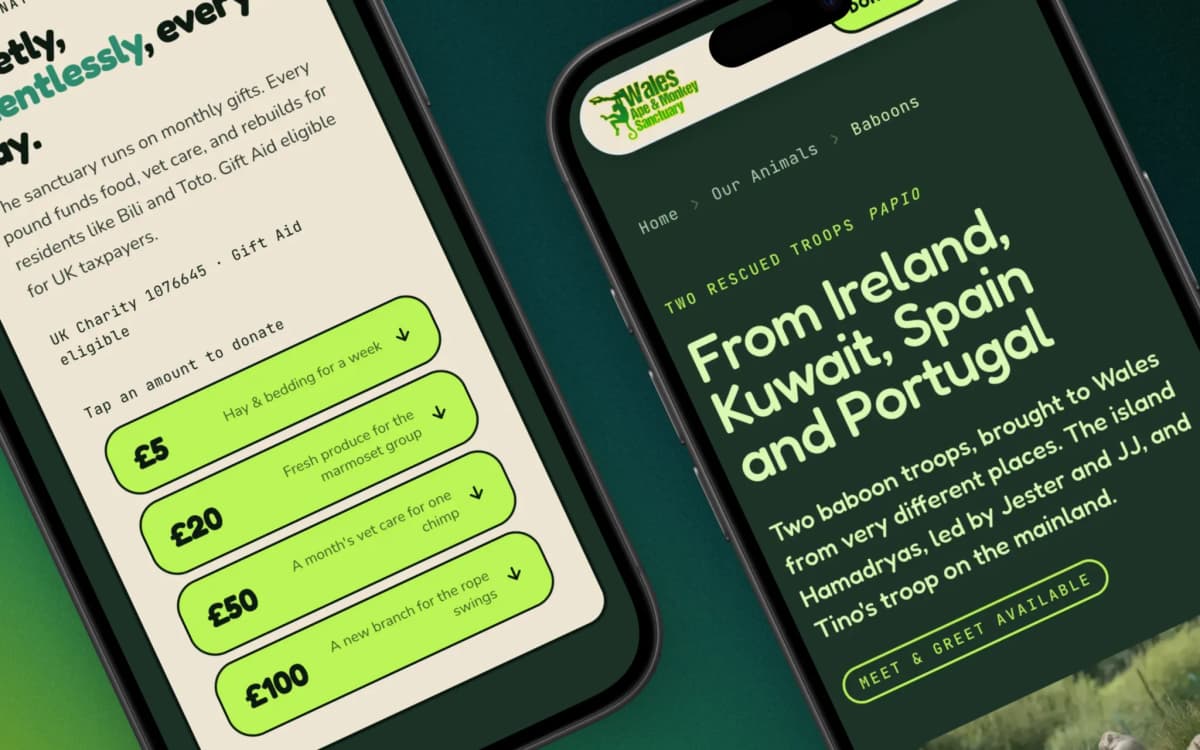
The third route is the one we build: the booking journey living on your own site, your brand, your rules, your customer data, no per-booking tax. This is not theoretical for us. The Wales Ape & Monkey Sanctuary takes Meet & Greet experience bookings directly through the site we built, and Coal Bunker's site books factory visits and even overnight stays in their show lodge, a booking flow that doubles as their best sales tool. Neither pays a platform a penny per booking.
The free link rents you convenience. The platform rents you demand. Your own website is the only one of the three that you keep.
Built-in booking earns its cost when any of these are true: bookings involve money up front (deposits kill no-shows and platforms charge handsomely for the privilege), the booking is the product (stays, experiences, hire, courses), your brand matters to the conversion, or volume is high enough that per-booking fees sting. It is overkill for a sole trader's consultation diary, and we will say so when it is.
The three routes side by side
| Route | Cost shape | Who owns the customer | Honestly best for |
|---|---|---|---|
| Free scheduling link | Free, then tiered monthly | Mostly you | Consultations, quotes, one-to-one time |
| Industry platform | Subscription plus commissions or per-booking fees | The platform | Discovery while building a client base |
| Built into your website | Build cost once, £39 +VAT monthly upkeep with us | You, entirely | Deposits, experiences, hire, brand-led businesses |
Mixing routes is not just allowed, it is usually right: a physio might run the free link for assessments while the platform fills quiet slots; a restaurant might keep the reservation network for tourists while regulars book direct. The mistake is drift, ending up on the expensive route by default because nobody ever did the arithmetic.
Bolted on versus built in
One quiet conversion detail decides more bookings than any feature list: what it feels like to book. A "Book now" button that ejects the visitor to a third-party domain with different fonts, a cookie wall and a login prompt sheds real customers at the exact moment they had decided to buy. A booking flow that continues seamlessly on the site that earned the trust converts a visibly higher share of the same visitors. This is why we treat booking as part of the build rather than a plugin bolted on afterwards: the flow inherits the site's speed, its design and its credibility, and the confirmation email comes from your name. Whichever route you choose, judge it on a phone, as a stranger, at the moment of paying, because that is where bookings die.
The worked example: deposits against no-shows
Numbers settle this argument faster than features do, so here is the arithmetic we run with clients. Take a therapist, tutor or aesthetics practitioner charging £45 a session and losing three bookings a month to no-shows: that is £1,620 a year walking out of an empty room. A booking flow that takes a £15 deposit at the moment of booking typically collapses no-shows to near zero, because the psychology changes the instant money moves; the deposit is not revenue protection so much as commitment engineering.
Now price the three routes against that £1,620. The free link needs a paid tier to take payments, call it £10 to £15 a month, £120 to £180 a year, a clear win if it works. A platform takes its subscription plus a slice of transactions, still usually a win, minus the customer-ownership trade. Built into your own site, deposit-taking is part of a one-off build at our published tiers, £675 to £1,350 +VAT for most small businesses, with the £39 +VAT monthly plan underneath, and after year one the only ongoing cost is upkeep you needed anyway. The route that wins depends on your volume, but the decision stops being abstract the moment you write down what no-shows and commissions actually cost you a year.
Four questions that pick your route
Skip the feature comparisons and answer these instead. How many bookings a week, honestly, now and in a year? Does a no-show cost you real money, and would a deposit fix it? Does the customer need to stay yours, their email, their history, their repeat visit, or is rented demand acceptable for now? And who updates the calendar when things change, because the best system is the one your actual staff will actually keep current. Two minutes with those four answers sorts almost every business cleanly into one of the three routes, or a deliberate mix.
The plain next step
If the answers point at the free link, take it tonight and spend nothing. If they point at a platform, go in with the commission maths written down and a plan to convert regulars to direct. And if they point at booking built into your own site, that is a scoped, one-off build conversation: send us what you take bookings for through the contact page and we will tell you what the flow should look like and what it costs against our published prices, including, sometimes, "keep the free link, it suits you". No obligation, and the examples above are live sites you can click around before deciding anything.
Rather have this handled?
Everything in this guide is what we do all day for Welsh businesses: custom-coded sites, local SEO and a listing that stays busy.
Frequently asked questions.
It depends which of three routes fits: a free scheduling link like Calendly for simple time slots, an industry platform where rented demand is worth the commission, or booking built into your own website when deposits, brand or customer ownership matter. The honest answer is often a deliberate mix.
For consultations, quotes and one-to-one sessions, genuinely yes, and the free tier costs nothing to try. You have outgrown it when you need deposits, multiple staff and services, or a booking journey that stays on your own branded website.
Marketplace platforms typically charge commission on bookings they introduce, and per-booking or per-cover fees are common in hospitality. The deeper cost is customer ownership: the platform holds the relationship and lists your competitors one tap away.
As part of our builds, booking and deposit flows sit within the £675 to £1,350 +VAT tiers for most small businesses, with £39 +VAT monthly upkeep and no per-booking fees. The Sanctuary's experience bookings and Coal Bunker's factory-visit and stay bookings both run this way.
Take a deposit at the moment of booking. Money moving changes the psychology, and no-shows typically collapse to near zero. Three missed £45 appointments a month costs £1,620 a year, so almost any deposit-capable route pays for itself.
Jack Warner
Founder, WebDev Wales · 28 August 2026
Keep reading.


No obligation, replies within 24 hours
Rather have it handled for you.
Reading about local SEO is free. So is the quote for having every bit of it done properly, every month.