
Church website design: the welcome, the giving and the hall.
A church website has three real jobs: welcome the stranger, take a gift with Gift Aid attached, and rent out the hall. What each needs, with honest costs.
Church website design is a smaller job than most agencies pretend and a more important one than most churches assume. The website's real work is three things: telling a stranger when the service starts and what walking in will feel like, taking a gift with Gift Aid attached, and renting out the hall. A church that only needs the first can honestly get by on a free template; one that needs all three is looking at a professional build from £675 +VAT. This guide, written from a studio in the Welsh valleys where the chapel is often still the biggest building in the village, covers what actually matters and what your congregation can safely ignore.
The website is for the person who is not there yet
Your congregation already knows the service time. The website exists for everyone else: the newcomer who just moved to town, the family wondering about a christening, the person in a hard week typing "church near me" at eleven on a Saturday night. That last visitor is the one to build for. They are not researching theology; they are working up the nerve to walk into a room full of strangers, and the site either lowers that threshold or raises it.
Lowering it takes specifics, not mission statements. When the services are, exactly. Where the door is and where to park. What to wear, whether children are welcome and what happens with them, how long it lasts, what the music is like. A photograph of the actual congregation doing actual things beats a stock sunbeam every time, and a plain paragraph called "Your first visit" converts more nervous Saturday-night searchers than anything else a church can publish. Alongside the newcomer stand two quieter audiences: the community groups who want your hall, and your own members checking the rota, and the site should serve all three without making any of them dig.
The Sunday morning test
Here is the test to run on your current site tonight: from your phone, can a stranger find this week's service time, the full address and a phone number that answers, inside thirty seconds? A remarkable number of church websites fail it, showing last December's carol service on the homepage in June. The fix is less about design than about honesty over upkeep: build the site so the three facts that matter are on the front page, and so a volunteer can update them without ringing a developer. If notices change weekly, the site needs an events area a rota member can edit; if the pattern never changes, say so plainly and let the page stand.
Google runs the same test. "Church in Bridgend" and "chapel near me" resolve through the map pack, which means a complete Google Business Profile with accurate hours, photos and reviews is as important as the website itself, and it is free. Our guide to getting your business on Google Maps applies to churches word for word.
If the honest answer is that nobody in the congregation has the time, our web design service builds church sites volunteers can actually run, with published prices and no surprises for the treasurer.
Online giving, done properly
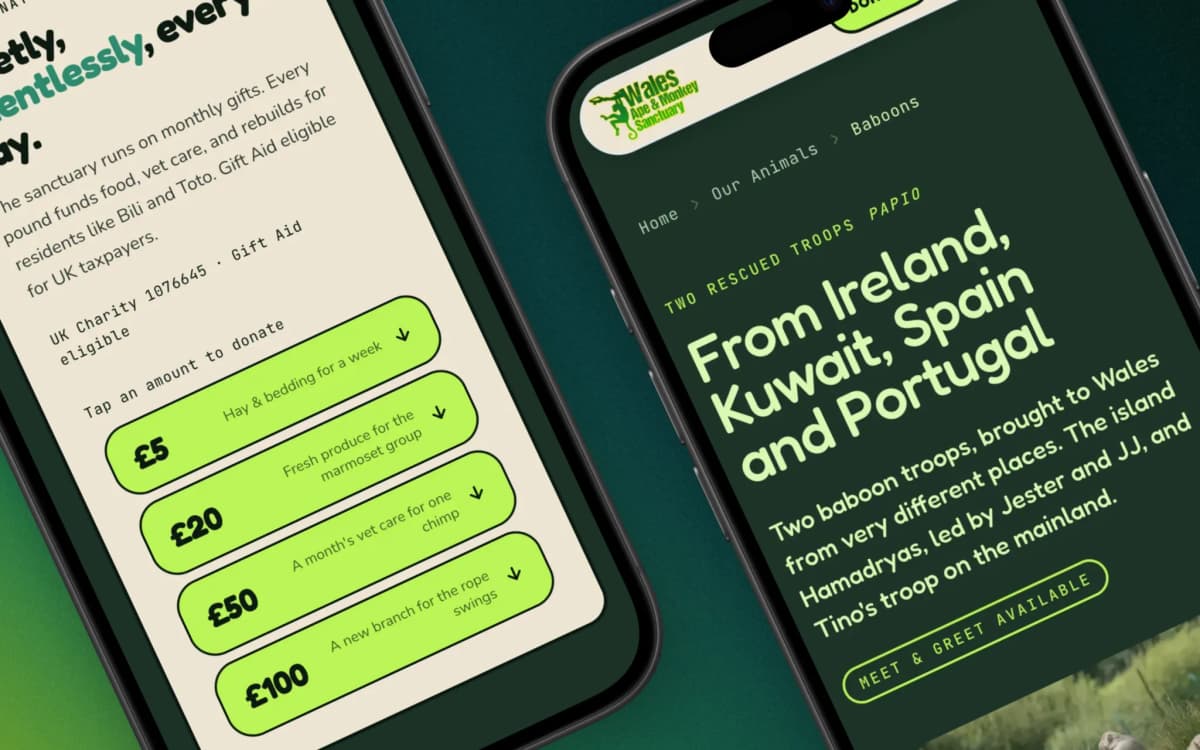
The collection plate now has a digital half, and doing it properly is worth real money. A giving page should take a gift in under a minute, accept a custom amount, and build the Gift Aid declaration into the form itself, because Gift Aid adds 25p to every eligible pound at no cost to the giver, and a declaration captured at the moment of giving is one the treasurer never has to chase. We build donation flows to exactly this standard: on the Wales Ape & Monkey Sanctuary's site the whole journey, custom amount, Gift Aid declaration, confirmation, works one-handed on a phone, and the same pattern transfers to a chapel unchanged.
Two honest cautions from that work. First, put the giving link where a moved visitor actually is, on the page about the work the gift supports, not only in a menu. Second, keep the page free of guilt and clutter alike; people give more readily to a church that asks plainly and thanks warmly than to one that stages a fundraising campaign on every page.
The hall is a search term
If your church has a hall, the website has a second business to run. "Hall hire Neath", "party venue Carmarthen", "toddler group near me": these are real searches with real revenue behind them, and most church halls are invisible to every one of them. A proper hall page carries photographs, capacity, facilities, honest prices, availability and a booking contact, and it will quietly out-earn its build cost for years. The same page also tells the town what already happens in the building, the foodbank, the youth club, the Welsh class, which is mission and marketing in the same breath.
We have seen how far this logic scales. When we built the site for The Poplars, a 70-acre Christian retreat centre in Herefordshire hosting church groups of 25 to 150, the pages that mattered were the practical ones: room-by-room capacities, published pricing tiers, and 13 testimonials from church leaders who had actually brought their congregations. Group organisers book certainty, not atmosphere. A church hall page is the same build in miniature, and the churches that treat it that way fill their weekday calendars.
A church website succeeds when a stranger can find the door, a giver can find the form, and the town can find the hall. Everything else is decoration.
The boring pages that carry the trust
Churches hold a particular kind of public trust, and a few unglamorous pages carry it. Most churches are charities in law; if yours is registered, the charity number belongs in the footer alongside the registered name. A safeguarding page with the named safeguarding officer and a direct contact is expected by every major denomination and, more importantly, by every parent choosing a youth group. Add who leads the church and how to reach a human, a privacy note if you collect any details, and accessibility taken seriously, larger text, decent contrast, captions on recorded services, because a congregation usually spans every age and ability in town. None of this is exciting. All of it is checked, quietly, by exactly the people you most want to reassure.
Template, builder or professional build
The honest decision table, treasurer's edition:
| Your situation | Right answer | Why |
|---|---|---|
| Small congregation, one service, no hall, a willing volunteer | Free template or simple builder | The Sunday morning test can be passed for nothing but diligence |
| Regular activities, giving online, a hall to fill | Professional build | The site earns money and runs on volunteer time, so it must be easy to update |
| Several churches sharing one ministry team | Professional build, one shared site | One well-kept site beats four abandoned ones |
| A retreat centre, venue or church business | Professional build with booking | Organisers book certainty; the site is the sales team |
We say the first row out loud because it is true, and a church that only needs presence should not pay us £1,350 for it. Where the build is justified, our published tiers apply unchanged: Essential at £675 +VAT, Professional at £1,350 +VAT with giving, hall and events done properly, Bespoke from £4,000 +VAT for the retreat-centre end of the scale, all with the £39 +VAT monthly plan and every figure on the pricing page where your church council can see it before anyone commits. Church money is given money, and we price like we remember that.
Chapels, Cymraeg and the Welsh picture
Wales built more chapels per head than almost anywhere on earth, and the survivors carry names, histories and communities that a template cannot hold. Two local notes belong in any Welsh church's plan. First, language: a fully bilingual site is a real undertaking, but a Welsh-language welcome, service details in both languages where worship is bilingual, and Cymraeg named plainly where it is spoken cost little and mean much, particularly in the west and north. Second, federation: many Welsh chapels and parishes now share ministers across several buildings, and the right answer is almost always one shared, well-tended site with a clear page per church, rather than four separate sites each maintained by nobody. The charity mechanics, Gift Aid, trustees, registration, are the same ones our charity website design guide walks through in full.
The plain next step
Run the Sunday morning test tonight, and look at the hall page if you have a hall. If either fails, the fix is a scoped, one-off build that volunteers can run afterwards, not a subscription or a redesign committee. Send us what you have through the contact page and you will get a straight answer, including, for the smallest churches, "keep the free template and spend the money on the roof". Published prices, no obligation, and you deal with Jack directly, who has built for a sanctuary, a CIC and a retreat centre and knows the difference between a congregation and a customer.
Rather have this handled?
Everything in this guide is what we do all day for Welsh businesses: custom-coded sites, local SEO and a listing that stays busy.
Frequently asked questions.
A small congregation with a volunteer can pass the basics on a free template for nothing. A professional build with online giving, an events area volunteers can edit and a proper hall page runs £675 to £1,350 +VAT at our published prices, with £39 +VAT monthly for hosting and upkeep; retreat centres and venues with booking needs run from £4,000 +VAT.
Service times, the full address and parking, a 'your first visit' page for newcomers, a giving page with Gift Aid built in, a hall hire page if you have a hall, the charity number in the footer, and a named safeguarding contact. Photographs of the real congregation beat stock imagery everywhere.
Gift Aid adds 25p to every £1 a UK taxpayer gives, at no cost to the giver. The declaration should be a checkbox inside the giving form itself, capturing name and address at the moment of donation, so the treasurer never has to chase paperwork afterwards.
Usually yes. Where chapels or parishes share a ministry team, one well-maintained site with a clear page per church almost always serves better than several sites each updated by nobody. Google and newcomers both prefer one current source over four stale ones.
Mostly through the map pack: 'church near me' and 'church in <town>' resolve through Google Business Profiles before websites. A complete profile with accurate service times, photos and reviews is free and matters as much as the site itself.
Jack Warner
Founder, WebDev Wales · 21 August 2026

No obligation, replies within 24 hours
Rather have it handled for you.
Reading about local SEO is free. So is the quote for having every bit of it done properly, every month.