
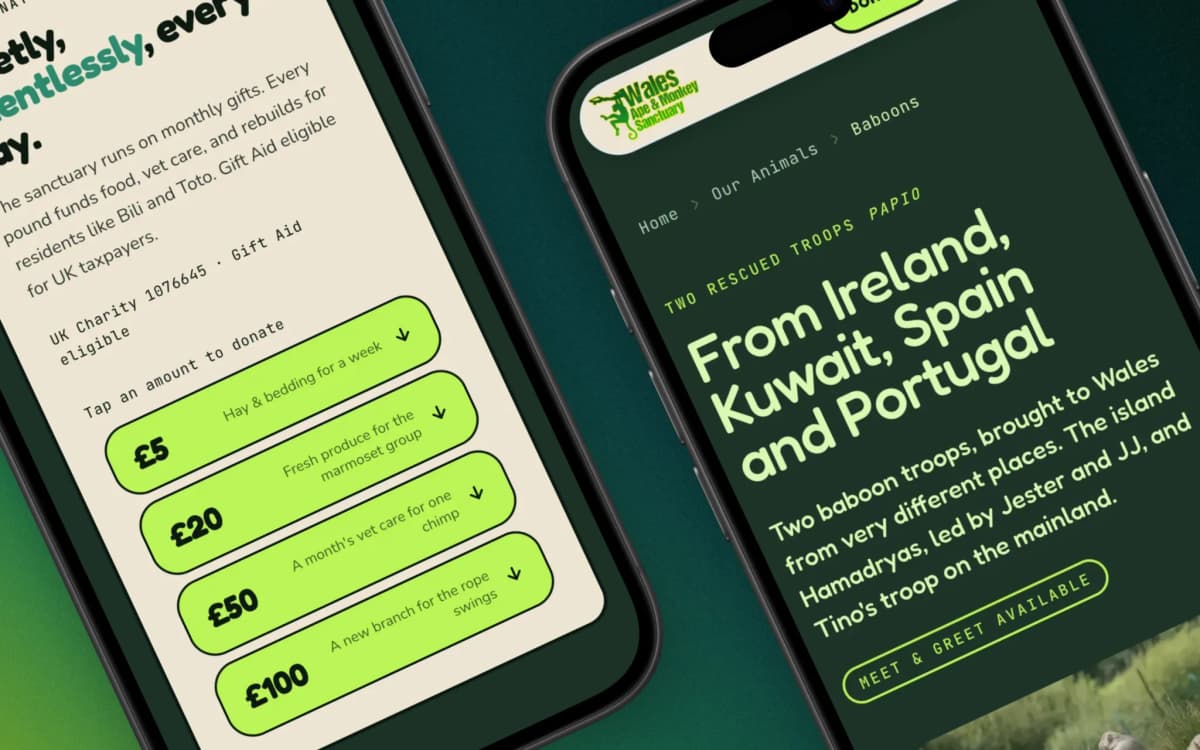
IT company website design: winning B2B clients before the first call.
What an IT support or networking company's website needs to pass procurement: a published support model, the shape of the price, verifiable accreditations and case studies with numbers, from £1,350 +VAT.
An IT company website is read by a buyer who has already decided to shortlist before they speak to anyone, so its job is to pass procurement before the first call. The sites that win managed-support and infrastructure contracts in South Wales and beyond are the ones that say who they serve, publish a real support model with response times, give the shape of the price, and prove delivery with named case studies and verifiable accreditations. We have built five of them, for Pendragon Networks, Datanet Group, Packet Collection, Trace Warrior and Jack It Up, and this guide sets out what those builds have in common, what procurement teams actually check, and what a site like this costs.
The buyer is reading a procurement pack, not a brochure
The person choosing an IT company is rarely browsing. An operations director has been let down by the current provider, an office manager has been told to find three quotes, or a finance lead needs a cyber-insurance renewal to go through. Each of them opens your site with a checklist: can you support an organisation like ours, can you keep our data safe, what is included, how fast do you respond, what will it cost, and who else have you done this for. If the homepage answers with "complete IT solutions for businesses of all sizes" and a wall of vendor logos, they cannot tick a single box and they leave.
The fix is a positioning statement in plain English above the fold: who you serve by size and sector, where you work, what you provide, and the business outcome. "Managed IT support for 20 to 150 user firms across South Wales, with a Swansea service desk and a one-hour response on critical faults" is a sentence a buyer can act on. When we built the Pendragon Networks site, the whole structure followed that discipline: six core services, each on its own page, with the certifications and project showcases arranged so a facilities manager at a healthcare provider could qualify them without a phone call.
The six pages that do the selling
An IT company site needs more pages than a trades site and fewer than it usually has. These are the six that carry the weight, and each exists because a buyer asks a specific question on the way to a decision.
| Page | The buyer's question | What earns its place |
|---|---|---|
| One page per service | Do you do the thing I need? | Managed support, cyber security, Microsoft 365 and cloud, backup and recovery, connectivity, projects: each with what is included, what is excluded, onboarding and a relevant case study |
| Support model and SLA | What happens when something breaks? | Hours, channels, priority definitions, response and resolution targets, escalation, exclusions |
| Pricing or packages | Roughly what will this cost? | Tiers, per-user bands or from prices, what sits outside the monthly fee |
| Sector pages | Do you understand firms like mine? | A handful of sectors written from real work, never thirty generated near-duplicates |
| Case studies | Have you done it before? | Client context, the problem, the scope, measured results, a named quote |
| Security and compliance | Will you pass our due diligence? | Accreditations with scope and dates, insurance levels, a summary of your controls, a security pack on request |
Datanet Group's site runs to sixteen service pages because structured cabling, fibre, wireless, CCTV and access control are genuinely separate purchases with separate searches, and the build was shaped around that; a smaller managed-service provider needs six to eight. The test for every page is the same: if it cannot name the question it answers, it is padding.
If you would rather have this structured for you than brief it from scratch, our web design service has built it five times for IT and networking firms, with published prices and no lock-in.
Badges need a sentence, not a logo
Procurement teams in 2026 do not take an accreditation logo at face value; they check the scope. Cyber Essentials and Cyber Essentials Plus should be shown with the level, the certified legal entity and the renewal date, because public-sector and regulated buyers often require the Plus level to be maintained for the life of a contract. ISO 27001 should say who certified you, what the scope covers and whether it includes the service desk and the hosting you actually sell. "Microsoft Partner" on its own means little now; the current programme uses Solutions Partner designations for areas such as Modern Work, Security and Infrastructure, and a buyer wants to know which one you hold and what your team can run after the implementation.
The rule we apply on every build is one line of explanation per badge, with a link to the verification where one exists. A row of unexplained logos, some of them expired, lowers trust rather than raising it. Datanet's ISO certifications sit on the site with their meaning stated, which is why they reinforce credibility instead of decorating the footer. Our guide to website security essentials covers the same point from the other side: a company selling security has to be seen practising it.
Publish the support model, with real numbers
"Fast, friendly support" is not a service level. The page a buyer reads most carefully is the one that says what happens at nine o'clock on a Monday when the server is down, and it should cover support hours, how to raise a fault, how priorities are defined, what you promise to do and by when, how escalation works and what is excluded. The distinction that matters most is response against resolution: acknowledging a critical ticket in thirty minutes is not the same as fixing it in thirty minutes, and a site that blurs the two creates a dispute later.
| Priority | Example | Response target | Resolution or workaround target |
|---|---|---|---|
| P1 critical | Site-wide outage, ransomware event | 30 to 60 minutes | Work continues until restored |
| P2 major | A service down for a team | 1 hour in contracted hours | Same business day |
| P3 user | One person cannot print or log in | 4 hours | Next business day |
| P4 request | New starter, software change | 1 business day | Agreed per request |
Those figures are illustrative; publish the ones you can keep. The page should also say whether "24/7" means engineers or a portal, whether on-site attendance is included and where, and how service is reported each month. Pendragon's remote support runs around the clock, and the site says so plainly rather than hinting at it.
Show the shape of the price
The most common objection from IT firms is that pricing cannot be published because every environment is different. That is true of the exact figure and untrue of the shape. A buyer needs to know whether you charge per user, per device or per site, what a typical 25-user firm pays, what sits outside the monthly fee (licensing, hardware, projects, out-of-hours), the contract length and whether VAT is included. Publishing that loses you nobody you could have won and removes the friction that sends a prospect to a competitor who did publish it.
We have watched this work across very different IT businesses. Jack It Up in Neath publishes fixed repair prices in tables, and the detailed FAQ beside them reduced the phone calls that used to ask what things cost. Packet Collection took it further with an interactive solution explorer and interactive pricing, so a prospect qualifies themselves before they ever send an enquiry, and Trace Warrior sells a technical product through a pricing comparison that a non-technical buyer can read. Different models, same principle: the price has a shape, and the website shows it.
"WebDev Wales absolutely nailed the brief for our site. The team delivered a fast, responsive, and visually slick website built with modern tech, optimised for SEO and performance from day one." · Director, Packet Collection
Case studies a procurement team can actually use
Client logos are the weakest proof on an IT website, because they say nothing about what was done. A case study that procurement can use states the client context (sector, size, sites), the problem they came with, the scope you delivered, the measured result and a named quote where the client permits one. "Improved IT" is not a result; a reduced ticket backlog, a passed audit, a completed migration with a date, or a cyber-insurance renewal that went through is. Pendragon's case study on our own site records the contracts the website helped it win with healthcare providers, which is the kind of specific, sector-named outcome a buyer in a similar sector can map onto their own situation.
Your own website is the first technical test
An IT company's website is judged as a work sample. A buyer who notices a slow page, a certificate warning, a broken link or a layout that collapses on a phone draws the obvious conclusion about the firm's attention to detail. The site should load in well under two seconds on a mobile connection, run on HTTPS with proper security headers, pass basic accessibility checks and carry a clean cookie and privacy setup. None of this is exotic, and all of it is checked more often than IT firms assume, because the person checking has the tools to do it. Every site we build for this sector ships on a modern, statically rendered stack for exactly that reason: speed and security are the first thing a technical buyer measures, and the result has to survive measurement.
Local, national, or both
The last structural decision is geography, and it changes the site. A managed-service provider living on "IT support Swansea" and "IT support Cardiff" searches needs area pages for the towns it genuinely serves, a Google Business Profile in the IT support category with reviews that mention response, and a service desk address a local buyer recognises. A specialist selling nationwide needs the opposite emphasis: the service pages carry the ranking, and the location signals support rather than lead. Datanet's build combined sixteen service pages with nationwide location targeting and still won its home search for structured cabling in Swindon, which is the pattern for a firm that sells across the UK from one base. If the local search side is the part you are missing, our SEO and performance service handles it for IT firms that already have a site worth ranking.
What an IT company website costs, and the next step
| Route | Typical cost | What you actually get |
|---|---|---|
| DIY website builder | £10 to £30 a month | A template; the SLA, pricing and compliance pages are whatever you write yourself, and the speed is whatever the platform allows |
| Template agency site | £500 to £1,500 | A tech theme filled in for you; usually no pricing structure and a logo wall in place of a compliance page |
| Our Professional build | £1,350 +VAT | Up to ten pages: service pages, support model, pricing shape, case studies, security page and the search setup to rank them |
| Our Bespoke build | From £4,000 +VAT | Sixteen-page service structures like Datanet's, interactive pricing or solution explorers like Packet Collection's, portals and integrations |
Most IT and networking firms land in Professional; the ones selling many distinct services or wanting a pricing tool land in Bespoke. Every figure is on our pricing page, monthly plans run from £39 +VAT for hosting, security and updates, and there is no lock-in. If your site is a logo wall with a contact form underneath it, the fix is a site built as a procurement pack: positioning, service pages, a published support model, the shape of your pricing and case studies with numbers in them. Ring 07916 214843 or start with the web design service page; the first conversation costs nothing, there is no obligation, and you deal directly with Jack from brief to launch, as Pendragon, Datanet and Packet Collection did.
Rather have this handled?
Everything in this guide is what we do all day for Welsh businesses: custom-coded sites, local SEO and a listing that stays busy.
Frequently asked questions.
A plain positioning statement, a page per service with inclusions and exclusions, a support and SLA page with priority definitions and response targets, a pricing or packages page, a few genuine sector pages, case studies with measured results and a security and compliance page that explains each accreditation.
Publish the shape of the price even if the exact figure needs a conversation: per-user or per-device bands, from prices, what a typical 25-user firm pays, what sits outside the monthly fee and the contract length. Buyers who cannot see the shape go to the competitor who shows it.
Whether the accreditations are current and in scope for the service sold, whether the SLA states response and resolution separately, whether 24/7 means engineers or a portal, whether case studies carry numbers and names, and whether the website itself is fast, secure and accessible.
DIY builders run £10 to £30 a month and template agency sites £500 to £1,500. With us, most IT and networking firms fit the Professional build at £1,350 +VAT for up to ten pages; multi-service structures, interactive pricing tools or portals sit in Bespoke from £4,000 +VAT, each with a monthly plan from £39 +VAT.
A managed-service provider winning IT support plus town searches needs area pages, a Google Business Profile in the IT support category and a recognisable service desk address. A nationwide specialist ranks on its service pages, with location as support; Datanet Group's sixteen service pages and nationwide targeting are that pattern.
Jack Warner
Founder, WebDev Wales · 1 November 2026
Keep reading.



No obligation, replies within 24 hours
Rather have it handled for you.
Reading about local SEO is free. So is the quote for having every bit of it done properly, every month.