
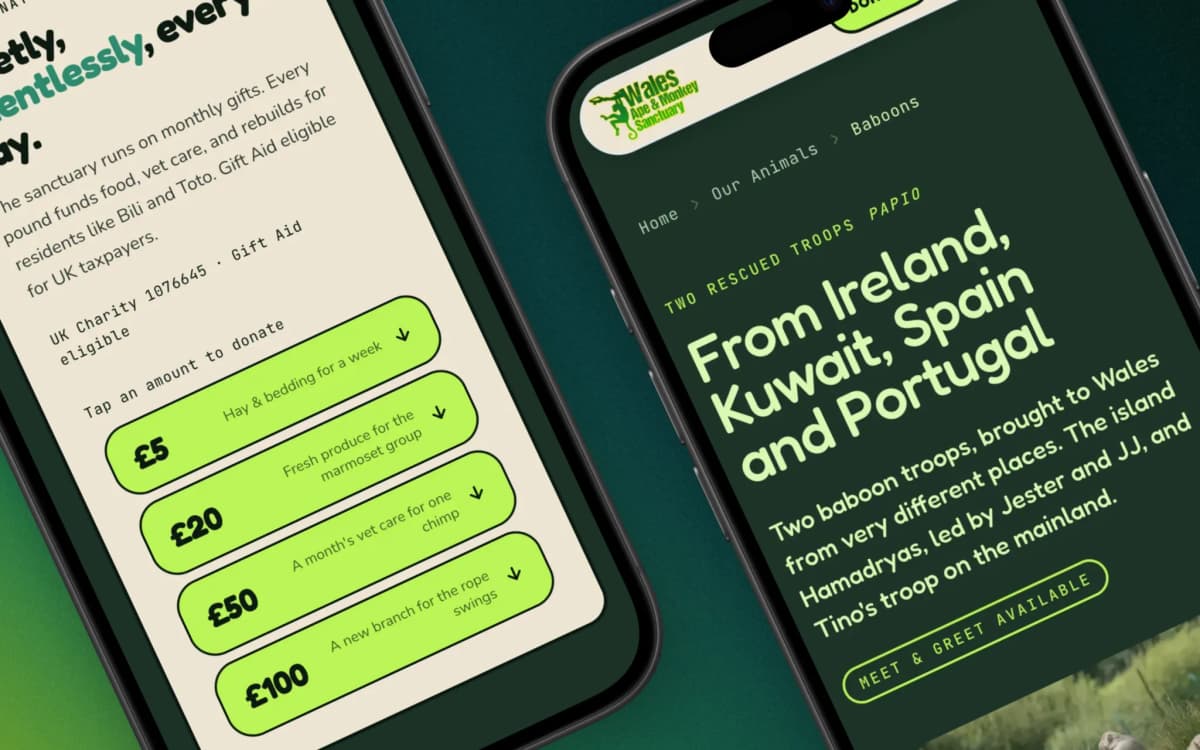
Carpenter website design: letting the work win the quote.
What a carpenter or joiner's website needs: a gallery that sells, a page per specialism, honest area coverage and a quote system built for bespoke work, from £675 +VAT.

A carpenter's website has an advantage most trades would kill for: the work photographs beautifully, and customers buy with their eyes. A joiner with a gallery of real fitted wardrobes, media walls and decking will win quotes from better-qualified rivals who have nothing to show, because for bespoke work the portfolio is the sales pitch. We have built websites for two South Wales carpentry businesses, LM Carpentry and Smokin' Joints Carpentry, both in the Neath area, and this guide covers what those builds taught us about what a carpenter's website needs, what it costs, and how it wins work a van sign and an Instagram page cannot.
Carpentry is bought by the eye
Nobody can inspect a boiler installation or judge a rewire from a photo, but everyone can see whether a fitted wardrobe is beautiful. That changes the entire shape of a carpentry website: the gallery is not a page on the site, it is the argument. When we built Smokin' Joints Carpentry's website, a 15-year business with over five hundred customers, we put the craftsmanship first and let it sell itself: kitchens, decking, bedroom furniture, doors, man caves and pergolas, all shown through an extensive gallery of genuine finished jobs, with testimonials threaded through the pages rather than hidden on one.
The rules that make a gallery convert are simple and mostly about honesty. Real jobs only, never stock photography, because homeowners can tell. Good light and a tidy room matter more than a good camera. And every photo should be the kind a customer could ask about: "the media wall like the third one, roughly what would that cost?" is exactly the enquiry a carpentry gallery exists to create.
Bespoke work needs a quote system, not a price list
Carpentry's awkward truth online is that almost nothing has a fixed price: every alcove, stair and garden is different, so a price page like a plumber's boiler menu is impossible. The answer is not to hide pricing entirely, it is to design the route to a quote so it is effortless. On LM Carpentry's website we built a quote-request modal that follows the visitor through the site, one tap away wherever the gallery has done its work, so the moment someone thinks "I want that" there is a form asking the right questions: what, roughly where, and photos of the space if they have them. Workshops making repeatable products can take this a step further into live-priced configurators, the pattern our manufacturing website design guide covers through Bramwood Timber's instant quote builder, but for one-off site work the effortless enquiry beats the clever calculator.
That structure serves both sides. The customer gets an answer grounded in their actual job rather than a guess, and the carpenter gets qualified enquiries with enough detail to price honestly, instead of twenty-minute phone calls about jobs that were never going to fit the diary. If your website's only contact route is a phone number you cannot answer from inside a loft, you are leaking exactly those enquiries.
If you would rather have the whole thing built properly, our web design service starts at £675 +VAT with published prices, and both carpentry sites above are live to judge for yourself.
Every specialism is its own search
The biggest search mistake carpentry websites make is one page called "services" listing everything from skirting to staircases. Customers do not search for carpentry; they search for the thing they want: fitted wardrobes, media wall installation, under-stairs storage, garden decking, kitchen fitting. Each of those is its own query with its own competition, and each deserves its own page with its own gallery.
LM Carpentry's site has six dedicated service pages, each with an individual gallery, because Leigh's specialisms, under-stairs storage, media walls, fitted wardrobes, stair refurbishments, are exactly the phrases homeowners type. A single services list can never rank for six different searches; six focused pages can, and our own Search Console shows the pattern working: searches like carpenter Neath reach our site at positions one to four, riding on the carpentry pages we have built and written about.
Trust works differently for in-home trades
A carpenter spends days inside a customer's house, which makes the trust question more personal than for outdoor trades. The website's job is to answer it before it is asked. Qualifications belong on the surface, not the certificates drawer: LM Carpentry's NVQ Level 3 is displayed prominently across the site because it separates a trained carpenter from anyone with a van and a mitre saw. Years and volume tell their own story, Smokin' Joints' fifteen years and five hundred customers do more reassuring than any adjective. And testimonials work hardest when they sit next to the relevant work rather than on a separate reviews page.
"I placed my trust in Jack to design my website to reflect my business. From the first meeting to set the expectations through to design and completion, Jack made it simple for me. Truly professional service." · Jason Berry, Smokin' Joints Carpentry
That quote is about our build process, but notice what it is really describing: trust, expectations, simplicity. Your customers want exactly the same from you, and your website is where they decide whether they will get it.
The five-town pattern: winning beyond your home patch
A carpenter's realistic working radius covers several towns, but a website that only ever says one town name only competes in one. When we built LM Carpentry's site we added dedicated area pages for Neath, Swansea, Bridgend, Port Talbot and Porthcawl, the five towns Leigh genuinely covers, so a "fitted wardrobes Swansea" search meets a page about exactly that, rather than nothing. It is the same logic we apply to our own web design in Neath page and across our location pages: Google matches pages to places, so the places you serve need pages.
The honesty rule matters here: area pages for towns you never work in are worthless to everyone. Pick the towns your van actually visits, write each page for that town, and let the mesh grow with the business.
Instagram is the sketchbook, the website is the shop
Most carpenters already market themselves visually on Instagram or Facebook, and the feed is genuinely useful: it keeps followers warm and shows work in progress. What it cannot do is be found: Instagram posts do not rank on Google, a feed cannot hold six service pages or a quote system, and an algorithm decides who sees your work. The website and the feed are not rivals; the feed brings the audience you already have, the website wins the strangers searching for fitted wardrobes at 9pm. Post the job to Instagram, then give it a permanent home in the website gallery where searchers can find it for years.
A worked example: what one specialism page is worth
Put honest numbers on it. Say a fitted-wardrobe job averages £1,800 and a media wall £1,200, and your website's specialism pages win you one extra job a month between them, a deliberately modest assumption for pages that rank in five towns. That is somewhere between £14,000 and £21,000 of work a year, from a £675 build and a £39 monthly plan totalling about £1,143 in year one. Even if the site wins a single job a quarter, it has paid for itself twice over, and unlike a directory membership the asset keeps compounding: every gallery photo added and every review earned makes the same pages stronger.
Run the same arithmetic on the do-nothing option. The carpenter with no website wins none of those searches, and the referral customer who looks them up before ringing finds a Facebook page last updated in March, or nothing. Word of mouth still closes the job, but only when the mouth has somewhere to point.
What a carpenter website costs
| Route | Typical cost | The honest trade-off |
|---|---|---|
| Instagram or Facebook only | Free | Great for followers; invisible to Google searches |
| DIY website builder | £10 to £30 a month | You do the work; galleries and pages usually stay thin |
| Template build | £300 to £800 | Generic look; one services page, no area coverage |
| Custom build with us | From £675 +VAT | Gallery-first design, service and area pages, quote system; £39 +VAT monthly keeps it hosted and maintained |
The arithmetic for a carpenter is friendlier than most trades: bespoke work carries bespoke margins, and a single fitted-wardrobe or decking job won from search covers the cost of the Essential build outright. Everything we charge is on the pricing page, published rather than quoted.
The plain next step
If your carpentry work deserves better than a phone folder full of photos nobody searching can see, the fix is a website built the way the two above were: gallery first, a page per specialism, the towns you genuinely serve, and a quote route that follows the visitor. Ours start at £675 +VAT, both carpentry builds are live to inspect, and you deal directly with Jack from first call to launch, exactly as Leigh and Jason did. Start with the web design service or ring 07916 214843; no obligation, and every price is already published.
Rather have this handled?
Everything in this guide is what we do all day for Welsh businesses: custom-coded sites, local SEO and a listing that stays busy.
Frequently asked questions.
DIY builders run £10 to £30 a month, template builds £300 to £800, and a custom professional build from £675 +VAT with us, with the £39 +VAT monthly plan covering hosting, SSL, backups and upkeep. One bespoke job won from search typically covers the build cost.
It is excellent for keeping followers warm and useless for being found: Instagram posts do not rank on Google, so the homeowner searching fitted wardrobes plus your town will never see your feed. The website wins strangers; the feed keeps fans.
A gallery of real finished jobs, a dedicated page per specialism with its own photos, your qualifications and years established, testimonials beside the relevant work, the towns you genuinely cover, and a quote-request route that works from any page.
Not with a price list, which is impossible for made-to-measure work, but with a quote system that gathers the job, the rough location and photos of the space. It produces grounded quotes for you and fast answers for the customer.
Yes, with honest area pages. A dedicated page for each town you actually serve lets Google match you to searches in all of them; LM Carpentry's site covers five towns across South Wales exactly this way.
Jack Warner
Founder, WebDev Wales · 28 August 2026
Keep reading.


No obligation, replies within 24 hours
Rather have it handled for you.
Reading about local SEO is free. So is the quote for having every bit of it done properly, every month.